
Reference Tracks Are Palate Cleansers
You're not trying to match a curve. You're trying to remember what music sounds like.

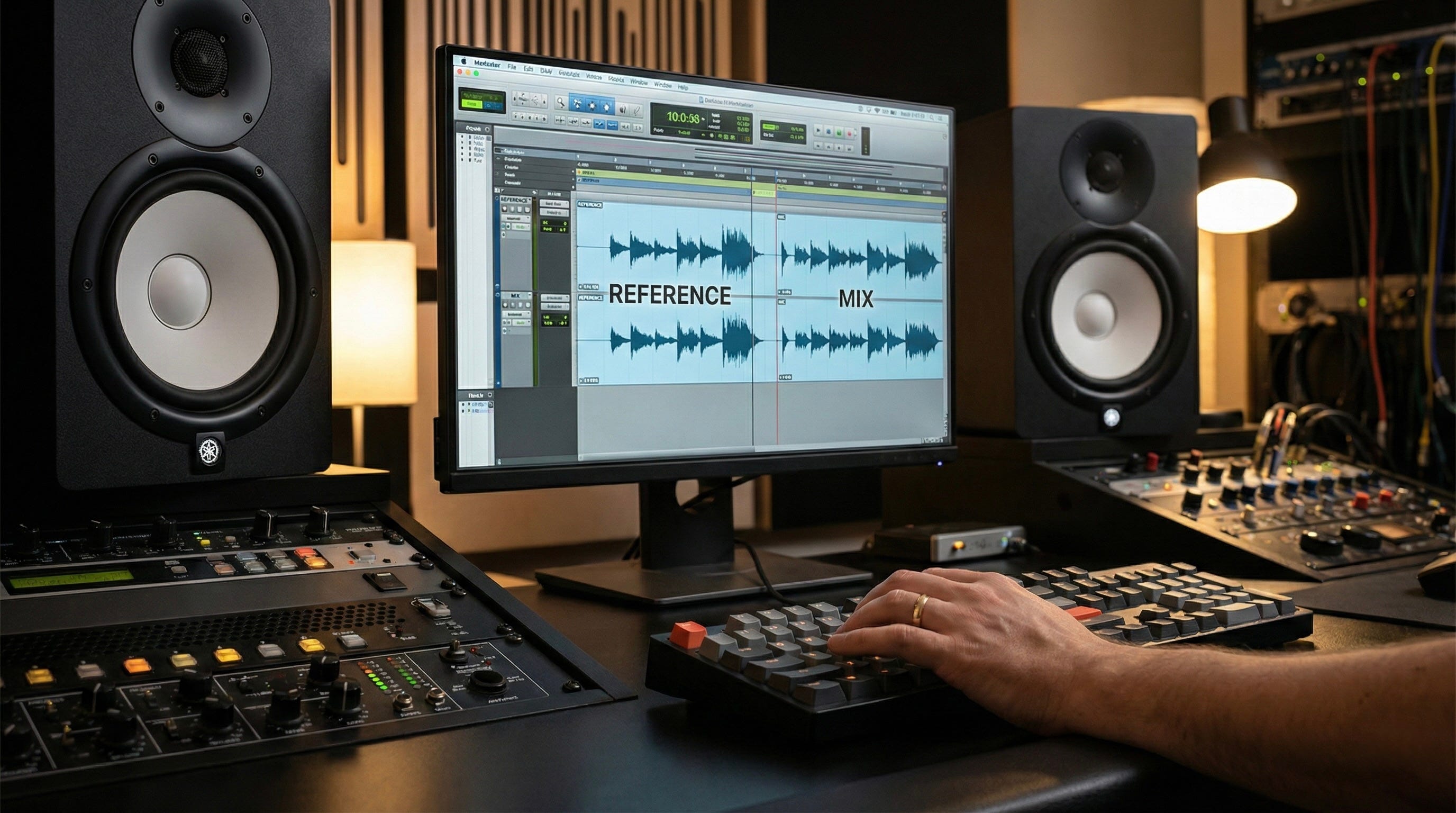
You’ve been mixing for three hours. The track sounds good. Better than good. The low end is tight, the vocal cuts, the width feels professional.
Then you A/B against a reference.
The commercial track explodes out of your speakers. It’s louder. Brighter. Wider. More present. More everything. Your mix, by comparison, sounds like it was recorded through a mattress.
Panic sets in. You reach for the EQ. Boost the high shelf. Push the limiter harder. Chase the curve.
This is the trap. And it’s backwards.
The False Assumption
The problem with reference tracks isn’t that people don’t use them. The problem is how they use them.
Most producers treat references like a target. The goal is to match: match the loudness, match the frequency curve, match the stereo width. Pull up a spectrum analyzer, overlay the two signals, and carve until the lines converge.
But here’s what actually happens when you chase the curve: you destroy your mix trying to become something it was never designed to be.
Your song has different instruments. Different arrangement. Different source recordings. A curve that works for a sparse vocal ballad will suffocate a dense electronic track. A curve that works for hip-hop will thin out rock guitars.
The reference isn’t a template. And the moment you treat it like one, you’ve stopped mixing and started erasing.
What References Actually Do
Here’s the perceptual shift: reference tracks don’t show you what your mix should sound like. They show you what your ears have forgotten.
Your brain is a liar. After thirty minutes of mixing, it adapts. The bass feels right because you’ve been living in your bass for an hour. The brightness feels balanced because your ears have recalibrated around your brightness. Everything makes sense inside the bubble you’ve built.
Then the reference pops the bubble.
The commercial track sounds better not because it is better, but because it’s different. Your ears haven’t adapted to it. You’re hearing it fresh. And in that freshness, you suddenly notice what you couldn’t notice before: the low-mids are muddy, the vocals are buried, the snare has no snap.
The reference is a palate cleanser. Like ginger between sushi courses. It resets your perception so you can taste your own mix again.

White Balance for Ears
Think about it like photography.
When you shoot under tungsten lights, the camera’s sensor doesn’t “see” the orange cast. It adapts. Everything looks normal through the viewfinder. Then you import the footage and realize: it’s all wrong. The whole image is warm in a way you didn’t notice when you were there.
White balance corrects this. You show the camera something that should be neutral, and it recalibrates.
Reference tracks are white balance for your ears. They show your brain something that should sound “normal,” and your perception recalibrates around it.
You’re not trying to match the reference. You’re trying to remember what music sounds like when you haven’t been staring at the same snare for two hours.
The Blind Switch
Here’s your listening experiment. It requires discipline, but it works.
Setup:
Import your reference track into your session
Level-match it to your mix (this is crucial: louder always sounds better)
Set up a way to switch instantly between your mix and the reference
The rule: don’t look.
Close your eyes. Switch randomly between the two. Don’t watch the screen to see which one is playing.
What to listen for:
Not frequency curves. Not loudness. Not technical measurements.
Listen for energy. Where does the energy live? Is it in the low end? The midrange? The top? Does the energy feel focused or diffuse? Does it hit you in the chest or float around your head?
Listen for space. Does the reference feel closer or further away? Wider or narrower? Is there air between the elements, or are they stacked on top of each other?
Listen for movement. Does the reference feel static or alive? Is there motion in the dynamics, or is it compressed flat?
When you open your eyes and see that you’re listening to your mix, ask: what’s the gap? Not in frequency. In feeling.
What the Gap Reveals
The gap between your mix and the reference is information. But you have to read it correctly.
If the reference feels “brighter,” the answer isn’t always to boost highs. Sometimes it means your midrange is too dense, and the highs can’t breathe. Sometimes it means your transients are too soft, and the perception of brightness is really a perception of attack.
If the reference feels “wider,” the answer isn’t always to spread things out. Width requires a strong center. Sometimes the reference feels wider because the center is locked, and yours is drifting.
If the reference feels “louder,” the answer is almost never to push the limiter harder. Perceived loudness comes from clarity, transient preservation, and frequency balance. If your mix is muddy, no amount of limiting will make it feel loud. It will just feel crushed and quiet.
The gap is a diagnostic. It tells you where to look. It doesn’t tell you what to do.
Choosing References
Not every reference is useful. Choose deliberately.
Match the energy, not the genre. A quiet acoustic reference won’t help you mix an aggressive electronic track, even if it’s a “great mix.” Find something with similar dynamics and density.
Use multiple references. One reference creates a single point of comparison. Three references create a range. If all three feel brighter than your mix, you have a problem. If one does and two don’t, you have a preference.
Rotate references. Your ears adapt to references too. If you use the same track for six months, you’ll start making everything sound like it. Keep a small library. Rotate.
Check your reference on your system. A reference that sounds amazing on studio monitors might reveal that your monitors have a bass bump. Know your playback chain before you trust the comparison.
The Decision
References aren’t targets. They’re mirrors.
They don’t show you what your mix should become. They show you what your ears have stopped hearing.
The next time you reach for a reference, don’t ask: how do I match this? Ask: what am I no longer able to hear?
Use references to reveal blindness... not to erase your taste.
Resources & Further Reading
On Perceptual Adaptation
Auditory Fatigue — Wikipedia The science behind why your ears stop hearing accurately after extended exposure. Temporary threshold shift explains why your mix sounds different after a break.
Mixing Secrets for the Small Studio — Mike Senior (Routledge, 2nd ed.) Chapter 10 covers reference mixing in depth. Senior’s approach to “competitive loudness” and level-matching is the most practical treatment I’ve found.
On Reference Track Technique
The Art of Mixing — David Gibson (Hal Leonard) Gibson’s visual approach to mixing includes extensive discussion of how to hear differences between mixes. The “3D” visualization method helps train the blind-switch skill.
Sound On Sound: Using Reference Tracks — Sound On Sound Practical guide to level-matching and choosing appropriate references. Covers the common mistake of comparing to mastered tracks without compensation.
Previously in ZenOne Music
Width Requires a Strong Center (2026-02-10) The predecessor to this article. Once you have an anchor, references become tools instead of weapons. Width is contrast; references reveal what you’ve stopped hearing.
This is part of a series on perceptual mixing. Previously: Width Requires a Strong Center. Next: Objectivity Decay: Knowing When the Mix Is Finished.