
Micro-Contrast Automation: Making Stillness Move
Your fader isn't a dial. It's a finger pointing at where attention goes next.

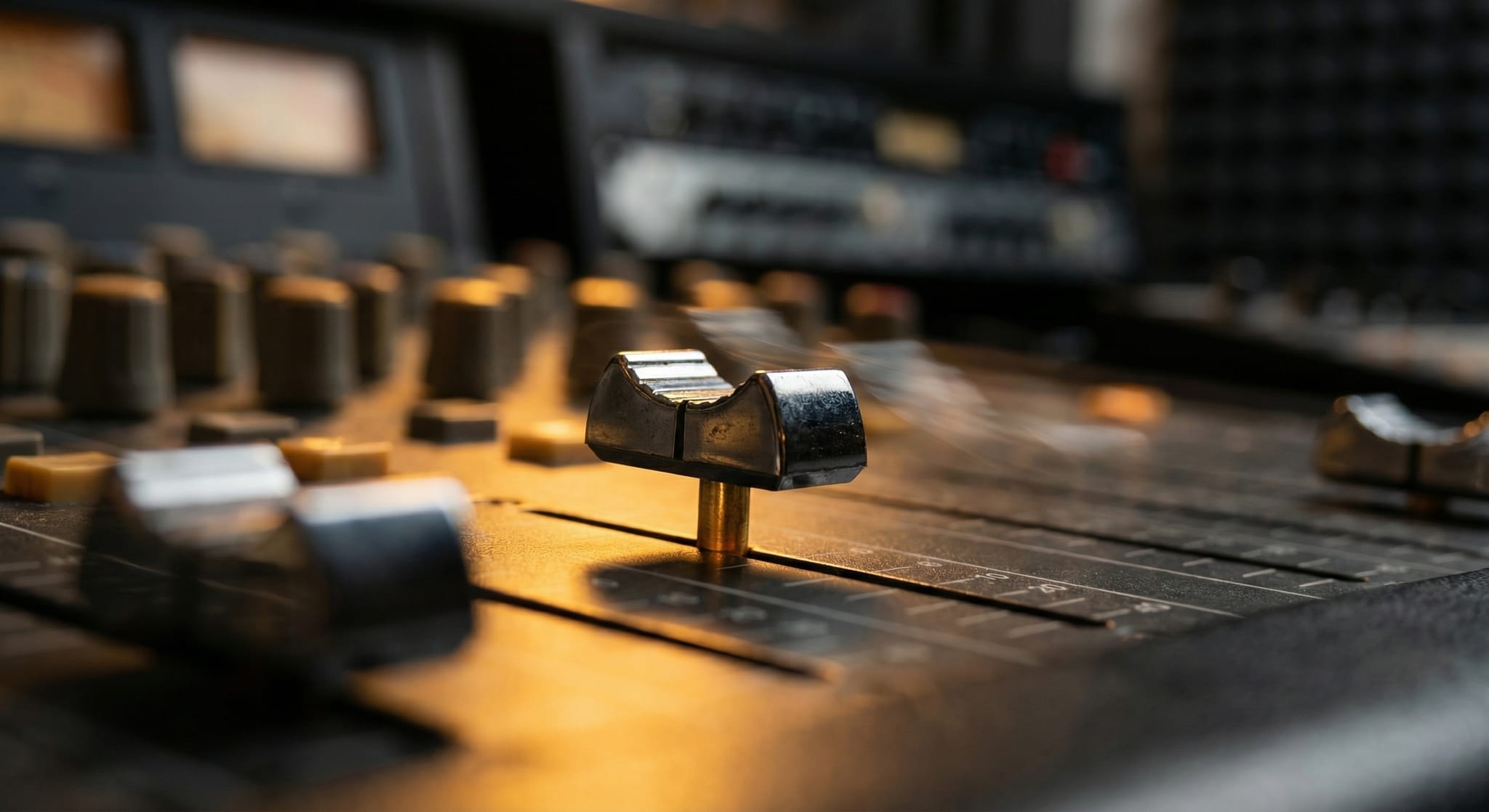
Eight bars in. You’re still pointing at the same place.
The loop is solid. The mix is clean. Nothing is technically wrong. But your attention settled somewhere around bar 3 and hasn’t moved since. The kick lands, the pads swell, the lead does exactly what it’s supposed to do. And you’ve already heard all of it. The next 8 bars will be identical.
This is not a programming problem. It’s not a sound design problem. It is an automation problem.
Faders Are Not Dials
The assumption most producers carry into automation is that faders exist to set levels and hold them there. You find the right balance, write it in, move on. Automation is for corrections: the vocal that drops in the second verse, the synth that gets buried when the crash hits, the bass that pokes out in the bridge.
This is reactive automation. You’re responding to problems. Not directing anything.
A fader set and left there isn’t neutral. It’s a guarantee that nothing will change. And when nothing changes, attention drifts. Not because your listeners aren’t paying attention: because the ear is a pattern-finding machine. After 4 to 6 repetitions of the same cycle, the brain stops logging it as new information and routes it to the background. Same level, same space, same tonal shape: that’s the definition of wallpaper. You built it. They stopped hearing it.
Automation Is Attention Choreography
Consider what a transient does to time. It marks an event. It says: something happened here. Your brain routes attention toward it. The contract is small, 5 to 30 milliseconds, but the perceptual effect is large. Something crossed a threshold and attention followed.
Automation does the same thing across a longer time scale. A half-dB push on the lead at bar 32 is an event. A reverb send creeping up 2dB through the breakdown is an event. A high-pass filter slowly opening over 16 bars is an event drawn across time. None of these are loud enough to register consciously. All of them are large enough to redirect attention.
The fader isn’t a dial. It’s a finger pointing.
Saturation reveals edges at the signal level: it makes the attack more perceptible, the transient more legible. Automation reveals edges at the arrangement level. One is spatial. The other is temporal. Both are about making the next moment feel different from the one before it. Different is what attention tracks.
The Size of the Move
This is where most automation goes wrong: the moves are too big. A ride from -10 to -6 in the chorus. A filter sweep so theatrical it announces its arrival. A volume swell you can hear building three bars away.
These are decorations. Decoration calls attention to itself. Direction moves attention forward, toward something else.
The moves that make a mix feel alive are almost always smaller than you expect. Half a dB on the kick entering the drop. A midrange push on a lead vocal sitting 2dB above its established level for 4 bars. A chorus depth change on a pad that takes 8 bars to reach its destination.
For level-based micro-contrast, the target range is 0.5 to 2dB per move. If you can hear the fader moving, the move is too large. If you can feel that something changed without identifying what: the move is right.
Filter automation follows the same principle. A high-pass cutoff moving 2 to 3 octaves over 16 bars is barely perceptible in the moment. Across a full breakdown, it’s the difference between a section that builds and one that stays flat the entire time.

The Experiment
You need a section of a mix. Something with 16 bars or more of fairly consistent material.
Close your eyes. Start playback. Point your index finger at where your attention is landing right now. Not where it should be. Where it actually is.
Move your finger as attention shifts. When something pulls your ear, follow it. When attention settles somewhere and holds, point there.
After 8 bars: did your finger move?
If it stayed in one position the entire time, automation is missing. The mix is static. Not broken, not wrong: static. Attention had nowhere to go.
Now find one element that could carry a move. Not the most important element. The one that, if it shifted slightly right before bar 5, might cause you to notice something different. Add a single move: 1dB over 2 bars. Play the section again. Point again.
The move will be smaller than what you expected to hear. The shift in attention will be larger than what you expected to feel.
Test it in mono. Micro-contrast that only registers in the stereo field is decorating the sides, not directing the center. If the attention shift holds in mono, the move is real. If it collapses, you moved the illusion, not the signal.
One Move at a Time
The instinct after running this experiment is to go back and automate everything. Rides on every element, filter sweeps throughout, constant small motions from start to finish.
Don’t.
Micro-contrast works because of scarcity. An event is an event because not everything is an event. If every fader is always in motion, none of the moves say anything. The pattern-finding machine hears constant variation as a new constant: background noise at a different frequency.
One move per section. One element changes while everything else holds still. That stillness is what makes the motion legible.
Saturation taught you to light the edge, not the whole wall. The same principle holds over time. One thing moves. The rest stays still long enough to make the motion matter.
Make the listener’s finger move.
What’s the smallest fader move you’ve made that changed how the whole section felt?