
Objectivity Decay: Knowing When the Mix Is Finished
Your brain adapts. Your ears lie. Here's how to know when to stop.

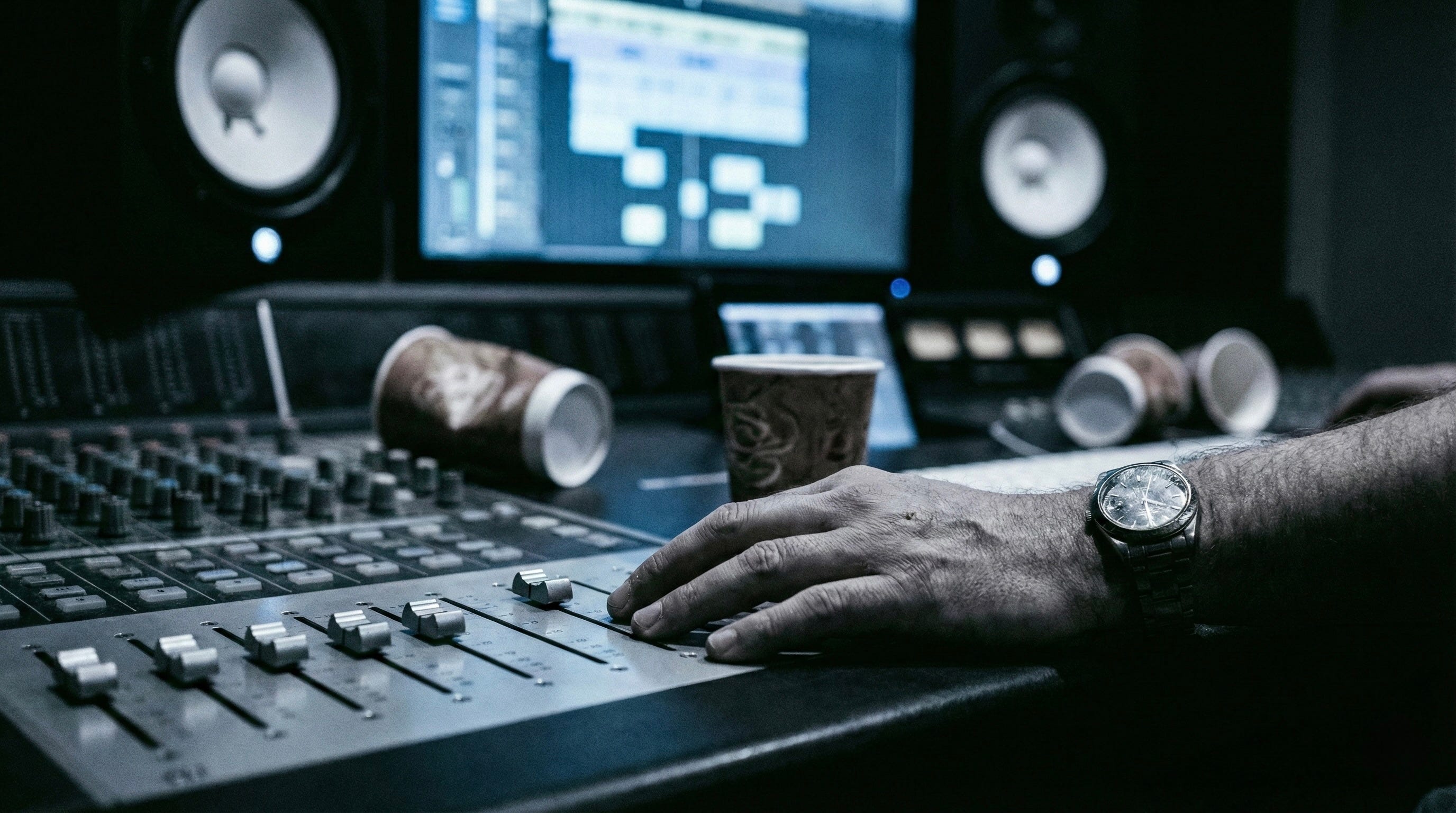
The mix sounds perfect. In your room. On your monitors. After six hours of tweaking.
You bounce it. Send it to your phone. Walk to the car.
And something is wrong.
The bass is bloated. The vocals are buried. The hi-hats you spent an hour taming are suddenly piercing.
This isn’t a translation problem. This is demoitis: the condition where a mix only sounds right in the environment where you made it.
And it doesn’t mean you’re a bad mixer. It means you’re a human being with a brain that adapts.
The False Assumption
Most producers believe that more time equals better results. That if you just keep working, keep comparing, keep adjusting, the mix will converge on perfection.
It won’t.
Here’s what actually happens: your brain habituates. It stops hearing what’s there. It starts hearing what it expects.
After thirty minutes, you’ve lost reliable high-frequency perception. After two hours, your sense of balance is drifting. After four hours, you’re making changes that sound like improvements but are actually just different.
Neuroscientists call this sensory adaptation. Your brain isn’t broken. It’s efficient. It tunes out constant stimuli so you can notice changes. But in mixing, that efficiency becomes a trap.
You think you’re refining. You’re actually just adjusting to your own distortions.
The Decay Curve
Objectivity isn’t binary. It decays.
In the first 30 minutes, you’re hearing the mix with relative accuracy. Your reference tracks still reset your perception. Your decisions have context.
By hour two, you’re compensating. If the room has a bass buildup, you’ve unconsciously accepted it as neutral. You’re EQing around a phantom.
By hour four, you’re in freefall. Every change feels meaningful. None of them are grounded. You’re chasing a moving target that only exists in your adapted brain.
This is why mixers who work fast often get better results than mixers who labor. It’s not about talent. It’s about catching the window before decay sets in.
The Room Trap
Demoitis is amplified by environment.
Your room has a frequency response. Your monitors have a curve. Your listening position has nulls and peaks. Over time, your brain maps all of this and compensates.
When you first sit down, you hear the room. After an hour, you hear through the room. The map becomes invisible.
Then you bounce the mix. Play it somewhere else. And suddenly you’re hearing without the compensation your brain had applied.
The bass isn’t actually different. Your perception of it is.
This is why the car test works. Not because car speakers are accurate. Because they’re different enough to break the adaptation.
The Listening Experiment
Here’s how to reclaim objectivity.
Step 1: The 24-hour break.
When you think you’re close to done, stop. Don’t touch the mix for a full day. Let your brain’s map decay. Let the adaptation reset.
Step 2: Listen from outside the door.
Before you sit down at the monitors, stand outside your studio. Play the mix at moderate volume. Listen through the door.
This sounds absurd. But it works.
You’re not hearing detail. You’re hearing balance. Energy. Shape. The things that matter most and drift the fastest.
If something feels wrong from outside the door, it’s wrong. No amount of in-room tweaking will fix a fundamental imbalance.
Step 3: One pass, one note.
Sit down. Listen once through. Write down the single most important change.
Not a list. Not five things. One thing.
If you can’t identify one clear problem, you’re done. The mix isn’t perfect. But your ability to objectively improve it has expired.

The Delta Test
Here’s the test I use:
After each change, I ask: can I hear the difference when I toggle bypass?
Not “do I think this is better.” Can I actually perceive the change?
If I can’t hear the delta, the change doesn’t exist. It’s placebo mixing. I’m adjusting to feel productive, not to improve the sound.
Early in a session, the deltas are obvious. A dB of gain on the vocal is clearly audible. A tweak to the reverb tail changes the space.
Late in a session, the deltas disappear. I’m moving knobs. The meters are moving. But my ears have stopped registering the difference.
That’s when I know the session is over.
Permission to Stop
Finishing a mix isn’t about reaching perfection. It’s about recognizing when your instrument of judgment, your own perception, has expired.
The mix doesn’t converge. Your objectivity decays.
More hours don’t help. Fresh ears do.
Reference tracks reset your perception, but only if you haven’t adapted to them too. Breaks reset your perception, but only if they’re long enough for the neural map to fade.
The skill isn’t knowing how to make the mix better. It’s knowing when you’ve lost the ability to tell.
Stop when you can’t hear the delta anymore.
Resources & Further Reading
Ear Fatigue: How to Prevent It When Producing & Mixing Music — EDMProd. Practical tips for managing listening fatigue during production sessions.
Ear Fatigue: Top Mixer Gives Advice On How To Deal With It — Production Expert. A professional mixer’s perspective on recognizing and managing ear fatigue.
Adaptation in the auditory system: an overview — Frontiers in Integrative Neuroscience. The science behind why your brain tunes out constant stimuli.
Mixing With Your Mind — Michael Stavrou. A philosophical and perceptual approach to mixing that goes deeper than knob-twisting.
This is part of a series on perceptual mixing.
Previously: Reference Tracks Are Palate Cleansers
Next: The Frequency Illusion